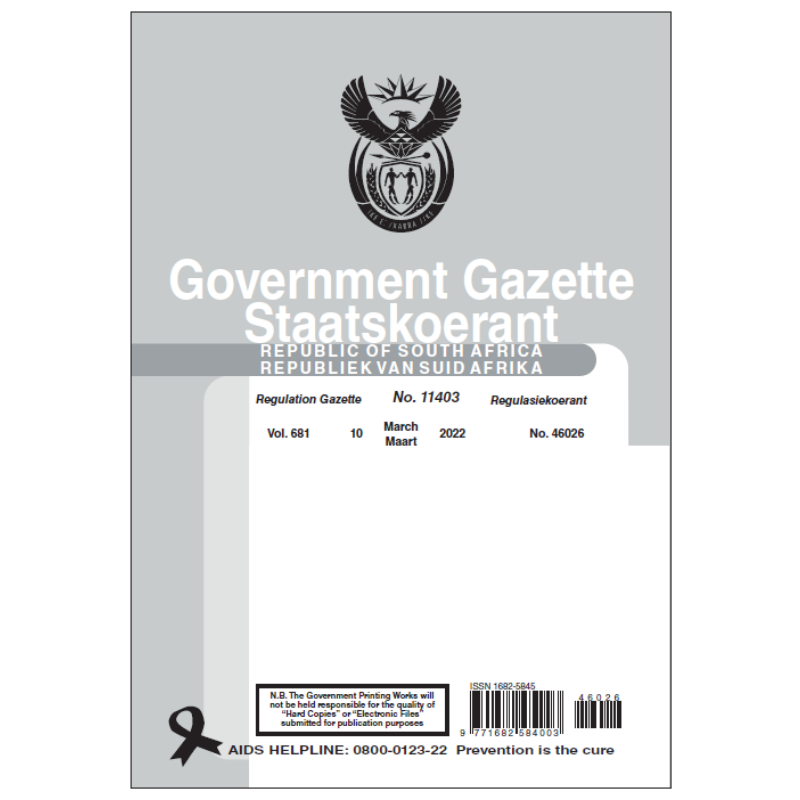
On the 10th March 2022, the National Treasury published the draft preferential procurement regulations for public comments. Click here to view : National Gazette Draft Prefential Procurement Regulations Comment 10-3-2022Read More
CONSTITUTIONAL COURT OF SOUTH AFRICA National Education Health and Allied Workers Union and Others v Minister of Public Service and Administration and Others; South African Democratic Teachers Union and Others v Department of Public Service and Administration and Others; Public Servants Association and Others v Minister of Public Service and Administration and Others; National Union...Read More
To all organs of state Preferential Procurement Regulations, 2017 – Minister of Finance v Afribusiness NPC [2022] ZACC 4 On Wednesday, 16 February 2022, the Constitutional Court handed down judgment in the application for leave to appeal against a judgment and order of the Supreme Court of Appeal. This application was brought by the Minister...Read More
The principle of legality is an integral component of the rule of law. This principle was best explained by the Constitutional Court in the judgement of Affordable Medicines Trust and others v The Minister of Health and others. This court, at paragraph 49, explained this principle in the following terms: “the exercise of public power...Read More
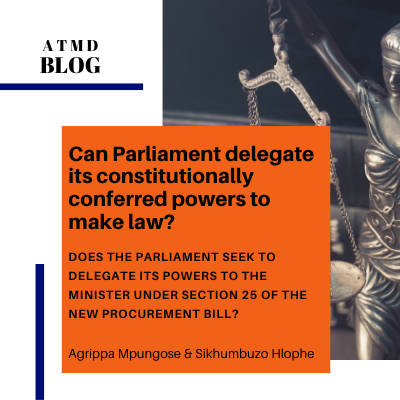
Can Parliament delegate its constitutionally conferred powers to make law? Does the Parliament seek to delegate its powers to the Minister under section 25 of the New Procurement Bill? In reading section 26 of the New Procurement Bill, the 2020 version, one is tempted to imagine a possibility of delegation of constitutionally conferred duties of...Read More
THE RULE OF LAW AND THE STATUS OF THE PUBLIC PROCUREMENT REGULATIONS (2017) The principle of legality is an integral component of the rule of law. This principle was best explained by the Constitutional Court in the judgement of Affordable Medicines Trust and others v The Minister of Health and others. This court, in paragraph...Read More
Section 6(1) of the Promotion of Administrative Justice Act 3 of 2000 (PAJA) provides that any person may institute proceedings in a court or a tribunal for the judicial review of an administrative action. Prior to the 30th of September 2016, the use of PAJA by organs of state was accepted as being legally correct,...Read More
Case law: State Information Technology Agency SOC Limited (SITA) v Gijima Holdings (Pty) Limited [2017] ZACC 40 Before SITA judgment, it was accepted as legally correct for organs of the state to rely on the provisions of the Promotion of Administrative Justice Act, 2000 (Act No. 3 of 2000) (PAJA) to ask courts to review...Read More
The Promotion of Administrative Justice Act, 2000 (Act No 3 of 2000) [PAJA] gives effect to the right to just administrative action in terms of Section 33 of the Constitution of the Republic of South Africa. Most of the decisions taken by officials of the government institutions while performing their duties as government employees usually...Read More
In situations where a tenderer is aggrieved with the decision of the municipality in respect of a tender and wants to challenge it in the court law, what would, in law, be deemed as “exhausting all internal remedies”? The first point in establishing the legal position i.e. rights of the tenderer and powers of the...Read More
We use cookies on our website to give you the most relevant experience by remembering your preferences and repeat visits. By clicking “Accept All”, you consent to the use of ALL the cookies. .
This website uses cookies to improve your experience while you navigate through the website. Out of these, the cookies that are categorized as necessary are stored on your browser as they are essential for the working of basic functionalities of the website. We also use third-party cookies that help us analyze and understand how you use this website. These cookies will be stored in your browser only with your consent. You also have the option to opt-out of these cookies. But opting out of some of these cookies may affect your browsing experience.
Necessary cookies are absolutely essential for the website to function properly. These cookies ensure basic functionalities and security features of the website, anonymously.
Cookie
Duration
Description
cookielawinfo-checkbox-analytics
11 months
This cookie is set by GDPR Cookie Consent plugin. The cookie is used to store the user consent for the cookies in the category "Analytics".
cookielawinfo-checkbox-functional
11 months
The cookie is set by GDPR cookie consent to record the user consent for the cookies in the category "Functional".
cookielawinfo-checkbox-necessary
11 months
This cookie is set by GDPR Cookie Consent plugin. The cookies is used to store the user consent for the cookies in the category "Necessary".
cookielawinfo-checkbox-others
11 months
This cookie is set by GDPR Cookie Consent plugin. The cookie is used to store the user consent for the cookies in the category "Other.
cookielawinfo-checkbox-performance
11 months
This cookie is set by GDPR Cookie Consent plugin. The cookie is used to store the user consent for the cookies in the category "Performance".
viewed_cookie_policy
11 months
The cookie is set by the GDPR Cookie Consent plugin and is used to store whether or not user has consented to the use of cookies. It does not store any personal data.
Functional cookies help to perform certain functionalities like sharing the content of the website on social media platforms, collect feedbacks, and other third-party features.
Performance cookies are used to understand and analyze the key performance indexes of the website which helps in delivering a better user experience for the visitors.
Analytical cookies are used to understand how visitors interact with the website. These cookies help provide information on metrics the number of visitors, bounce rate, traffic source, etc.
Advertisement cookies are used to provide visitors with relevant ads and marketing campaigns. These cookies track visitors across websites and collect information to provide customized ads.